Dear accounting firm owner…
Is this you?

Don’t you wish it wasn’t?
(Lol, good one, Ryan. But we’re accountants!)
Seriously, though…
You can absolutely build a firm that gives you more money and more freedom.
Right now, growth probably feels like the opposite of freedom.
But it isn’t growth that’s stealing your time.
It’s where you’re spending it!
Most firm owners are pouring their hours into a small handful of areas that feel productive in the moment but are capping how big (and free) their firm can become.
Let’s break down the 4 biggest ones.
The Time Wasters in Accounting Firms
You probably don’t think the items here are time wasters.
But they are costing you, and more freedom starts with admitting that.
1. Working With Clients
I get why this one’s tricky.
Clients are the lifeblood of accounting firms, so it must feel like being hands-on with them is the job.
Besides, you probably became an accountant to help clients.
What if I told you that you can still help clients without your personal involvement?
The firm owners I know who are drowning in hours are the ones personally handling their clients.
1-to-1 relationships feel productive.
They feel safe, even.
You know exactly what’s happening because you’re the one doing it.
But like I shared on LinkedIn, this type of work doesn’t scale.

Every new client you personally manage is another slice of your week gone.
Because that relationship now runs through you, and it’ll keep running through you until you actively do something about it.
Now, if you genuinely enjoy doing client work, please don’t let me talk you out of it.
Plenty of firm owners are wired that way, and there’s nothing wrong with that.
But enjoying something and it being a good use of your time aren’t the same thing.
A firm that gives you real freedom needs most (if not all) of those client interactions to be somewhere other than your personal calendar.
How to Start Delegating Client Work
Don’t try to delegate everything at once.
You’ll overwhelm yourself, overwhelm your team, and might quit halfway through.
Instead, start with one.
- Pick one client or one task. Something low-risk. Not your biggest client, not your most complicated file. Something small enough that if it goes sideways, it’s not a disaster.
- Hand it off completely. I mean completely, without you reviewing everything before it goes out. Get the whole thing off your plate!
- Pay attention to how it feels. If you find yourself checking in, second-guessing, or slowly taking it back… That’s not really about the client.
That’s about you.
If letting go of one small thing feels impossible, that tells you where your bottleneck is.
And usually, it has nothing to do with your team’s ability but your willingness to let go.
2. Admin Work
If I had to summarize admin work into just one sentence, I’d use this:
“It’s faster if I just do it.”
Let me know if you disagree. 😛
The trap here is that admin work feels like doing nothing.
But it never costs nothing!
Those small tasks happen every day, every week, stacking into hours you’ll never get back.
And if that doesn’t bother you enough…
Do you know how much value your business gets from you doing this personally?
ZERO.
Someone else can send those emails, fill out those forms, and manage that calendar.
But only you can decide where your firm is headed next.
Only you can build the relationships and make the calls that grow the business.
Every minute you spend on admin is a minute you’re not spending on the one thing nobody else can do in your firm.
How to Get Admin Work Off Your Plate
Good news:
Out of all the things in this list, this one’s the easiest to fix.
Here’s how to do it in the next week or two:
- Hire a virtual assistant. Even a part-time VA will help. If you need help, here’s a guide to hiring a VA for accounting firms.
- Write down 2 to 3 SOPs. Start with the recurring stuff you do on autopilot.
- Record a few Loom videos. Just hit record, do the task while narrating it, and send the video. Five minutes of screen recording beats an hour of writing instructions!
Your SOP could look something like this:
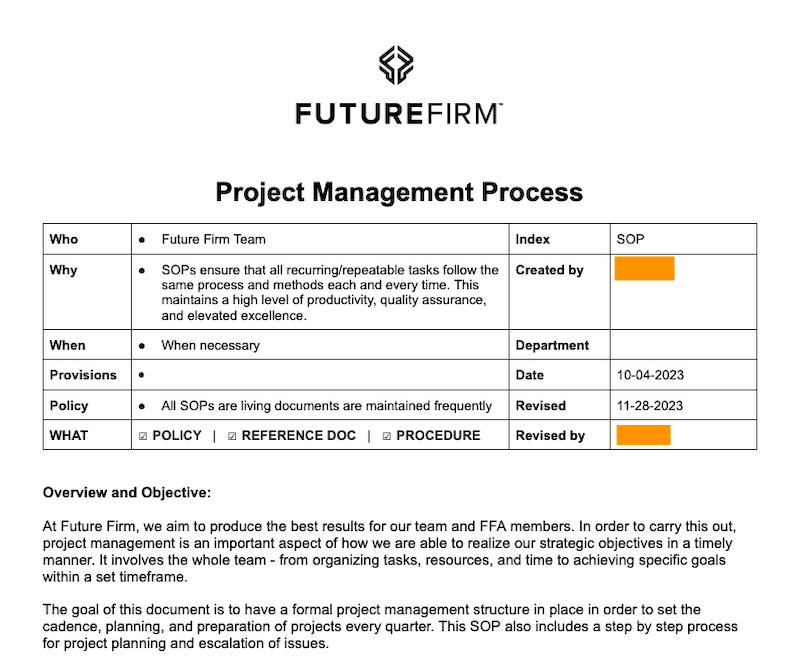
AI comes in handy here.
Instead of writing SOPs and recording videos separately, you can head straight to recording the video.
Then, grab the transcript, paste it into an AI tool like ChatGPT or Claude, and then use a prompt like this:
I’m an accounting firm owner. I just recorded a Loom video walking through a task, and I want you to turn the transcript below into a clear, practical SOP (Standard Operating Procedure) document for a team member (a VA or junior staff member) to follow.
Here’s what you need to know about the transcript:
– It’s spoken, not written, so it will include filler words, false starts, tangents, and me correcting myself mid-sentence (“actually, wait, let me back up”). Ignore all of that and extract only the actual instructions.
– I may not explain steps in the order I actually do them on screen. Reconstruct the correct logical order based on what I’m doing, not necessarily the order I say things.
– I’ll likely reference things on my screen (“click here,” “this button,” “over on the left”) without naming them clearly. Use context to infer what I’m referring to and name it specifically in the document (e.g., the actual button, tab, or field name if it’s inferable).
Structure the final document like this:
1. Title – a short, clear name for the task
2. Purpose – one or two sentences on why this task matters and when it should be done
3. Tools/Access Needed – anything the person needs before starting (software, logins, files)
4. Step-by-Step Instructions – numbered, specific, one action per step. Written so someone who has never seen the video could follow it and get the same result.
5. Notes & Exceptions – anything I mentioned that’s a “watch out for this” or “if X happens, do Y instead”
Keep the language simple and practical. This needs to work for someone reading it cold, without having watched the video. Don’t add steps I didn’t actually do, and don’t skip anything I did just because I explained it messily.
Here’s the transcript:
[PASTE TRANSCRIPT HERE]
If you’re looking for more ways to use AI tools to save time, I’ve got guides for you too:
Just make sure you’re careful not to share sensitive information with them!
3. Operations
If you’ve had “improve our processes” on your priority list for, like, a really long time…
You’re definitely not alone.
I talk to firm owners constantly who rank this stuff near the top of their to-do list.
Implementing new tech, building out processes, etc.
Almost every single one of them!
(But almost none of them ever get to it.)
Why?
Because it just isn’t their thing.
To give you a small preview, here are some of the recurring operations tasks at Future Firm:

Running “the internal engine” of a firm (i.e., systems, people, and deadlines) is a completely different skill set than doing the accounting work itself.
Some firm owners are genuinely good at it and enjoy it.
Most aren’t and don’t.
So, while you keep it on your to-do list because you know it’s important…
You never get to it because it competes with everything else that needs your attention now.
How to Hire for Operations
What you need is a dedicated Director of Operations or Chief Operating Officer.
Don’t go looking for a unicorn (e.g., an accountant/operations hybrid)!
Start looking by matching the hire to where your firm is right now.
- Under $1M: Look at part-time, fractional, or a consultant/agency. You don’t need someone full-time yet. At this stage, you just need someone who isn’t you running the internal engine.
- Around the $1M mark: This is usually when a full-time operations hire starts to make sense. The workload is finally there to justify it.
- Well past $1M: Start thinking COO-level. Someone senior enough to own the whole operation.
This Operations person will also serve as a buffer between you and everyone else in your firm.

Regardless of stage, don’t hire someone junior for this role.
And definitely don’t get an accountant from your team because they’re “pretty organized.”
Operations needs someone who’s done it many times before.
Someone who can take charge, not just take instructions.
To help you find this person, use ChatGPT’s Deep Research feature.
Instead of wading through a pile of applicants with a generic job posting, give it real context:
- Where is your firm at right now?
- What do you need this person to fix in the next 6 to 12 months?
- Where do you want the firm (and yourself) to be once they’re in the seat?
The more context you feed it, the better the results.
You can also post the role directly on LinkedIn, using titles like Operations Manager, Director of Operations, or Chief Operating Officer.
4. Doing Your Own Books
You’ve got a full team doing your clients’ bookkeeping, payroll, and reconciliations every single day.
You trust them with someone else’s business finances, someone else’s payroll, someone else’s money.
…
So why the heck are you still doing your own books?!
When I ran Xen Accounting, I didn’t touch my own bookkeeping or payroll.
My team did.
Same thing at Future Firm today.
I don’t do my own books.
(Below is an email from my accountant.)

There’s no reason for me to be the one doing it.
If you trust your team enough to handle it for clients, that trust should extend to your own firm too.
There’s no real distinction.
Numbers are numbers.
The only difference is that this time, it’s your name on it.
That doesn’t mean it has to run through you.
How to Hand Off Your Books
This one’s simple.
- Pick one function. Bookkeeping or payroll. Not both at once.
- Pick a specific team member. Name someone this month.
- Hand it off. Give them what they need, then let go of the rest.
If you catch yourself hesitating, ask yourself why.
Is it because your team can’t handle it?
(I bet it isn’t.)
Is it just habit, control, or a trust issue?
In almost every case, it’s just about you not being ready to let go.
What to Do With the Time You Get Back
Once you’ve done all of that stuff…
What’s next?
Freeing up your time doesn’t automatically make your firm or your life better.
It just means the hours are available.
What you do with them is what counts.
Work On Growth and Strategy
This is work that only you can do.
Often, these tasks get pushed aside because you’re buried in delivery work:
- Deciding whether to launch a new service
- Repositioning the firm around a niche or ideal client
- Fixing your pricing
- Building a real, actionable growth plan
These may not look urgent on any given day, but they don’t happen on their own.
They’re the work that scales your firm.
But they need constant, undivided attention.
Firm owners who protect their time are simply in a better position to grow their business effectively.
Become a Better Leader for Your Team
Delegation does not mean handing something off and walking away.
If you dump work on your team without support, training, or feedback, it doesn’t stay off your plate for long.
It comes back slower and messier.
You might find yourself frustrated that “delegation doesn’t work.”
So, use the time you get back to lead.
- Check in on how your team is doing
- Give real feedback instead of redoing their work
- Invest in training so they can handle more over time
- Be available for the questions that genuinely need you
Even if your firm doesn’t require your bandwidth to operate anymore, they will always need someone steering the ship.
And as the firm owner, that’s always going to be you.
Enjoy the Freedom!
Every hour feels like it should be doing something for the business.
That’s the accountant in all of us, always looking for the next problem to solve.
But some of that time back needs to just be yours.
Take a trip without checking your emails.
Leave your desk and take a walk for an hour.
I didn’t always get this right…
There were many times I’d physically be somewhere with my family and mentally still be back at the firm.
But nothing ever broke in my business. 🙂
These days, I find it much easier to completely disconnect from work for weeks at a time, enjoying views like this:

Freedom has to be intentional.
If you don’t use it, then it’s just unclaimed time.
Make sure to protect it.
Spend More Time on Valuable Work
There you have it!
Cut out the time wasters we covered above.
You might be surprised how much time you get back for more important things in your firm (and in your life).
Remember: not everything in your firm requires you.
So protect your time for the things that really do.
And if you’re ready to build an autopilot and scalable firm…
Go check out Future Firm Accelerate.
Good luck!